
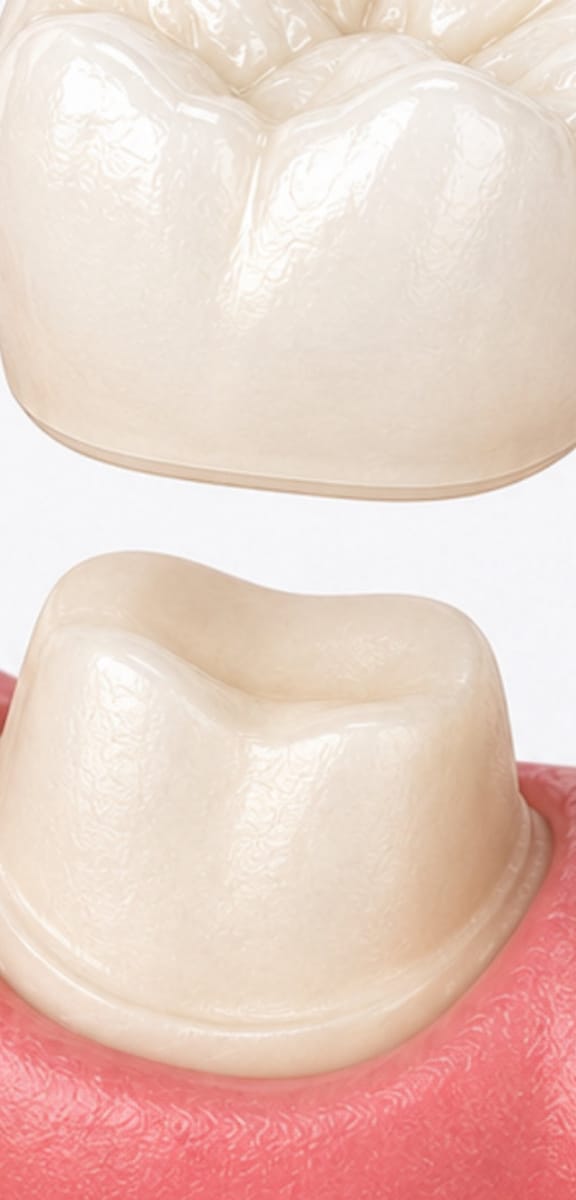

What does a dental crown do?
A crown covers the visible part of a tooth to restore its shape and function. It may be recommended when a tooth is weakened, broken, heavily restored, or needs protection after root canal treatment. Crowns also form the visible tooth on some dental implants.
At Tomlinson Dental, we assess how much healthy tooth remains before recommending full coverage. Ask why a crown is advised and whether a smaller restoration could meet the same need.
Sources: ADA: Crowns
What happens during crown treatment?
Assess and plan
We examine the tooth, consider symptoms and imaging, and discuss the restoration and material. Decay or a pulp problem may need attention first.
Prepare and record
The tooth is reshaped to make room for the crown. Impressions or a scan record the preparation and bite. A temporary crown may protect it while the final restoration is made.
Fit and review
The fit, contact with neighboring teeth, and bite are checked before the crown is secured. Tell us about any discomfort or a bite that feels uneven.
Sources: ADA: Crowns
What affects the cost of a crown?
The crown material, laboratory work, and condition of the tooth affect the fee. A build-up, root canal treatment, or other preparation may be a separate part of the plan.
Ask whether the quote includes the temporary crown, the final crown, and adjustment visits, and which additional treatment has been identified.
Payment and dental benefits
We accept cash and cards. Third-party financing is available, subject to approval.
Although we are not contracted with any dental insurance company, we gladly help submit claims so your provider can reimburse you directly. Payment is due in full at the time of service; we do not provide insurance estimates.
Review insurance and payment optionsCrown, onlay, or filling?
| Restoration | Coverage | Main question |
|---|---|---|
| Filling | Repairs the damaged area directly | Is enough sound tooth left to support it? |
| Onlay | Rebuilds part of the tooth and covers one or more cusps | Can partial coverage protect the affected area? |
| Crown | Covers the visible tooth | Does the remaining tooth need broader protection? |
The largest restoration is not automatically the best choice. We can explain how the location of a crack, remaining tooth structure, and bite affect the recommendation.
Sources: ADA: Crowns · ADA: Filling options
Looking after a crowned tooth
The natural tooth underneath still needs daily care. Brush with fluoride toothpaste and clean around the gumline and between teeth. Tell us about grinding, clenching, or repeated breakage so we can discuss protection.
A crown can loosen, chip, or need replacement; it does not prevent all future decay or guarantee that a tooth will never need further treatment. Contact us if the bite changes or you notice pain or movement.
Sources: ADA: Crowns
Dental crown questions
No. Root canal treatment addresses a pulp problem, while a crown restores and protects tooth structure. We assess whether one or both are needed.
Sources: AAE: Root canal treatment · ADA: Crowns
Contact the office for advice and an appointment. Keep the crown if you have it. Do not use household glue to attach it.
Crowns can be made from metal alloys, tooth-colored ceramics, or porcelain over a metal base. The tooth’s position, bite forces, available space, appearance, and material history help guide the choice. Ask which option is recommended for your tooth and why.
Sources: Leeds Teaching Hospitals: Crowns
A crown may need repair or replacement over time. We cannot promise a lifespan for an individual tooth; regular care and assessment remain important.
Related restorative care


Discuss a Dental Crown
We’ll explain whether your tooth needs a crown, a smaller repair, or a different treatment.
3907 North Boulevard, Tampa, FL 33603
Find us in Tampa, FL


Medically reviewed by Angella Tomlinson, DDS, PA